
We all think about suffering, and we have all suffered, are suffering, or will suffer to some degree, but leave it to Joseph Bentz to investigate the upside of pain, loss, and adversity. A professor of English at Azusa Pacific University, Bentz is also a novelist and writer of books related to the Christian experience. His latest book, Nothing is Wasted: How God Redeems What is Broken (Beacon Hill Press in Kansas City, 2016) explores the idea that redemptive elements are all around us and are even within the worst circumstances.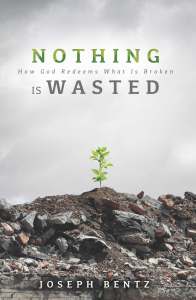
I was in a prayer group with Joe for a few years (the group is still running, but I have not attended in a long time), along with a few other professors in the Azusa Pacific University community, and I found him to be encouraging and persuasive. The group was formed to encourage one another for creative projects and endeavors, and to pray for one another as the struggles ensued. My husband and I plan to return to this remarkable group when more time has opened up for us, but I can say here that it is made up of gentle, uplifting individuals who are humble, productive, and inspirational. They have certainly known disappointments, struggles, and suffering, but they quietly persist in their efforts, their faith, and their kindness.
Joseph Bentz has written ten books, including five novels and five books related to Christian life. We met last week at Starbucks near the campus so that I could interview him about Nothing is Wasted.

Joe does not hesitate to confront the most difficult issues that Christians face, and yet his personal demeanor is calm, thoughtful, and gentle. Not opinionated, he nonetheless has some resolute ideas about our walk with God, our awareness of the overall context of our faith in Christ, and our choices as believers in the God of redemption and hope. His books include subjects that some of us prefer to avoid: God’s silence when we want him to speak to us (Silent God), the delay we experience when waiting for God to act, (When God Takes Too Long), and now the reality of suffering and God’s redemptive “song” in the midst of our troubles in Nothing is Wasted.

I was eager to ask him a few questions after I finished the book. A believer in Christ, I have nonetheless had a crisis of faith more than once, during a prolonged period of chronic pain due to a car accident neck injury, a series of disappointments, and cataclysmic church issues that threatened to derail my faith.
Me: When did you start writing this book, and what inspired it?
Joe: I started the book in 2013 and finished it in 2015. I was interested in the ways that “redemption” was scattered in unexpected places. I met many people at writers’ conferences who had suffered great pain and who were writing about their experiences. I met a woman at one of the conferences who had been hit by a car, and yet she talked about it as a life-changing, positive experience. I wondered what the perspective of others was about the painful things that had happened to them.
Me: What kind of research did you do for the book?
Joe: I read articles and books written by people who had experienced painful events, and I also spent time with others that I met who had suffered great losses. They gave me permission to tell their stories, as they wanted them to be told. They also wanted to help others who might be experiencing the same thing.
Me: It almost seems as if you are writing in response to St. John of the Cross and the Dark Night of the Soul.
Joe: That would be more prominent in Silent God and the issues I write about in that book. For this book, I had observed that many writers had dealt with great emotional pain and difficult circumstances, and I wanted to find out how it affected them. Were they bitter? Did they blame God? How did they deal with the effects of the tragedy or difficulty?
Me: I have struggled with the idea of what we can expect from God. Will he protect us? Does he prevent some tragedies? What can we look for in our ongoing walk as people of faith?
Joe: We can look for hints, echoes, and traces of redemption. Somehow, God will bring good out of the pain, both for ourselves and for others. The pain of our losses may never subside, and yet we can observe that good comes out of them in a variety of ways.
It is a theme song in the universe, according to Bentz. We are in a world of tragedy, disasters, and death, and yet despite the nature of the world, we will find the traces of redemption eventually, if we are open to them. We don’t have to find them, says Bentz. We can ignore them, succumb to bitterness and anger, abandon our faith. Or, we can celebrate the echoes, hints, and traces of good that we find, even in the worst of situations.
It might be tempting to enlarge upon the severity of the suffering that see in the world, and yet Joe Bentz can provide both a presence and an argument that challenges us to look beyond the suffering to God’s redemptive plan, which eventually culminates in eternity with him, although we have little knowledge about what that will look like.
This book is an invitation to see the best instead of the worst, a call to look up into heaven instead of down into the circumstances, and it is also a subtle, yet persuasive, call to redemption as well as a full-on confrontation with the worst that can happen. Here’s to Joseph Bentz for looking into the darkness and finding flashes of light.

Find out more about Joseph Bentz at his website, JosephBentz.com.
Order Nothing is Wasted from Amazon here.
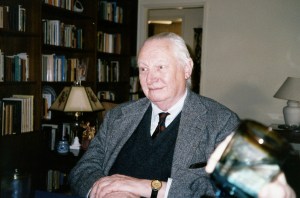 We never had a consensus about who actually started the group, but it was a toss up between Midge Sherwood, a mover and shaker who got the
  Joan Elizabeth White was a calm and delightful individual. We often had dinner together after a day of research at the library, waiting for the rush-hour traffic to subside. She lived in an apartment across the street from MacDonald’s, and I asked her once if she ate there occasionally. Her response: “Yes, almost every night. I really should reform.” After her car was stolen, for which we were all thankful, knowing she had become a less proficient driver as she aged, she took a taxi every day to the library.
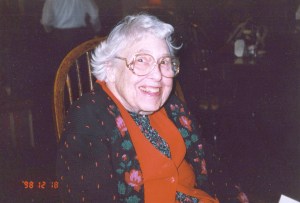 Kazuko Sugisaki spent half the year in the United States and the other half in Japan. She and Joan worked together for a time translating Japanese poetry and prose. Kazuko is a well known Anais Nin scholar and has written several
  Jeanne Nichols was a supremely engaging woman. Jeanne had taught English at Harbor College in Los Angeles, not too far from her lovely home on Mount Washington. Her book of poems,
  Her closest friend, Norma Almquist, was a warm, pleasant, and most interesting poet. Norma set out, early in life, to have as many different kinds of jobs as she could have. She was an airplane mechanic in the Women’s Marines, wrote field manuals for the Army’s Quartermaster Corps, edited a literary magazine, did social work, worked in factories, and taught English. After Jeanne’s children were grown, she and Norma traveled. We heard about their trip across the Nubian desert on camels, their island adventures, trips to India. Norma told me that she would get bored and hop a plane to Paris to sit on the Left Bank. A champion of light, humorous verse, Norma wrote a collection of it,

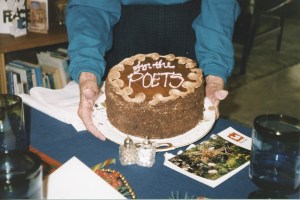
 For a time, I was the youngest member of the Live Poets, and I learned much from listening to them in conversation. What an honor to have known them all.
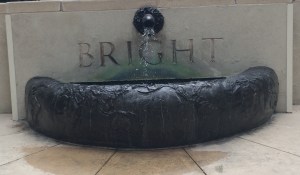
 Cold remedies and medications have prevented me from feeling clear, but I did have a few moments of recognizing what I need to do for the continuing path I am following. Perhaps the clearest moment was one of appreciating the beauty of a beach sunset.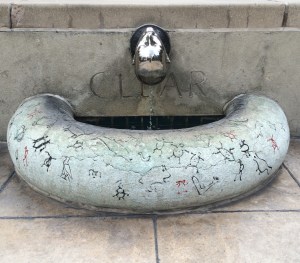


 Film crews have been setting up all day to film at 5th Street and Flower just beside the library, and I have enjoyed watching them unload huge lights, gigantic cord spirals, and other items I do not recognize. Amplifiers and generators? Storage containers? Electric tools? They have built a structure that looks like a portion of the street after an explosion, and now they are spreading around a black powder that will likely produce some special effects. We were told by the hotel staff that there will be shooting sounds and a car explosion at 10 p.m. tonight. With such a lively and interesting view, I am writing, contentedly settled at the desk in our room, where I will be for several more hours.
 I know many writers, poets, painters, and musicians, and as you would expect, they all have individual methods for their work, settings they like, environmental preferences. As Alexandra Enders noted in her article called “The Importance of Place: Where Writers Write and Why”:
 I am ultra-sensitive to the environment wherever I am. My long-suffering husband is the exact opposite. He can thrive and work almost anywhere, especially if he has a cup of coffee. My friends know that the ambiance in any given restaurant is supremely important, and it may take me a few minutes to select the right spot (away from bright light, chairs not too hard, tables not wobbly, tasteful décor, no brash TV noises, no traffic behind my chair). Thankfully, they usually allow me to select the space. My senses are so acute that loud noises can seem traumatic, bright light can feel like an assault, and the wrong person seated in the next booth or at the next table can ruin the day’s experience. At home, I can create the right environment, and when we are traveling or venturing out, I love it when an opportune setting is available. This desk at the Bonaventure is now a sacred spot, and as the sun and clouds shift and create new moods on the landscape, I am having a productive writing day.
 What is the setting in which you write? Are you particular or easygoing about your setting? Do you require certain accouterments? Whatever the case, we all seem to find our way through whatever impediments present themselves. Vive la différence!
 writingcustoms.com